Summit
Legal Tech: When AI starts working

Intro
Over the past few weeks, almost all the major providers in the legal market have unveiled so-called AI agents. These are no longer chatbots that answer a question. These are systems that read a statement of claim, propose a strategy, carry out research and draft the brief at the same time. The human comes into play at defined control points: approving the plan, checking the research, signing at the end. Oversight has therefore not disappeared. It has simply shifted elsewhere.
This is precisely where a problem lies that hardly anyone talks about. The work between control points used to be the work of newcomers to the profession. One in three HR managers plans to hire fewer newcomers by 2030. But if someone has never spent 40 hours on a brief themselves, how are they supposed to recognise in ten years’ time that the agent has got it wrong? Oversight requires experience. And experience arises from precisely the work that is now being automated.
On top of that comes a second imbalance. Law firms are upgrading, the judiciary is not keeping pace. Courts are already receiving AI-generated briefs running to hundreds of pages even in simple civil cases. When agents are writing on one side and judges are reading with a highlighter on the other, that is no longer equality of arms.
I do not want to demonise AI in law. It can make proceedings faster and the law more accessible. But we need a picture of what training, day-to-day law firm work and the judiciary should look like in three to five years, before the technology decides it for us.
This week, explained: When AI writes the legal brief
Anyone wanting to understand how legal work is currently changing needs to look to the US. On 17 September, OpenAI unveiled “Astra for Law”: its most powerful model, tuned for legal work, with its own search index for judgments, statutes and procedural rules. At launch there are 26 plugins from partners such as Thomson Reuters, iManage, Harvey and Legora. On 200 research tasks relating to US law, the model performed 40 per cent better, according to OpenAI, than the same AI using a standard web search. However, there is no comparison with the classic legal databases.
What this means in practice was demonstrated by Harvey and LexisNexis in early October. Their new workflow for motions to dismiss works like this: you upload the statement of claim. A planning agent proposes up to eight possible points of attack and rates each for strength. The lawyer approves the strategy, further agents carry out research, and a final agent drafts the document. Until now, an associate typically needs 40 to 50 hours for such a motion.
In the same week, the US law firm Cooley announced it would build an agent with Google that searches court files for confidential data and suggests redactions. What ultimately gets redacted is decided by lawyers. And AT&T is having its new internal legal unit, LegalEdge, develop AI workflows together with OpenAI. The major AI labs are no longer selling only to software providers. They are going directly into law firms and legal departments.
In Germany, the development has arrived, just more quietly. BMW is rolling out Legora across its entire legal department: for research, contract review, process management and initial drafts based on its own standards, directly in Word. Legora opened an office in Munich at the end of September. According to its own figures, more than 13,000 lawyers in Germany now work with the programme. At the start of the year it was around 3,000. The legal publishers are also restructuring: Wolters Kluwer has integrated international content on arbitration, competition and IP law into its AI workspace Libra, across eleven European countries. The logic behind it: an agent is only as good as the sources it can access.
In fairness, there is a gap between press release and day-to-day law firm practice. The trade portal Artificial Lawyer notes that most large law firms have long been using AI tools, yet their way of working has barely changed. An obvious reason is the business model: anyone billing by the hour has little incentive to turn 40 hours into four. Law.com also reports that the promised interfaces between tools often do not work as advertised. Precisely such gaps increase the risk of data leaks.
The pressure therefore comes from clients. AT&T plans to cut its list of external law firms from around 30 to 18 to 20 within two years and to favour firms that themselves use AI. And at the other end of the agents stands the judiciary. Federal Justice Minister Stefanie Hubig recently told the Rheinische Post: “It cannot be that courts are literally being buried under unstructured AI-generated text.” Her ministry intends to present a reform within six months so that courts can give parties clear requirements on how to submit their pleadings.
The solutions are on the table, they are just uncomfortable. Control points that actually check rather than merely rubber-stamp. Training in which young lawyers learn to review an agent instead of merely being replaced by it. The US law firm Ropes & Gray has first-year associates use around 20 per cent of their billable-hour target for AI training. And a judiciary equipped with powerful AI of its own. The agent writes in minutes. The signature remains human. The question is whether the human behind it still knows what they are signing.
The outlook ahead: London, Hamburg, Hannover
Today and tomorrow the industry meets at Legal Geek in London, followed by ClioCon in Boston on 25 and 26 October, and Legal Innovators UK on 4 and 5 November. It will be interesting to see whether law firms demonstrate there what the agents actually deliver in daily practice, or whether it remains at the demo stage.
On 19 November, the Conference of Justice Ministers will meet in Hamburg. The next Federal-Länder Digital Summit for the judiciary has also been announced for the autumn. The federal government plans to provide a total of 210 million euros for the digitalisation of the judiciary from 2027 to 2029. That may sound like a lot, but it amounts to 70 million euros a year for the judiciary across the federal government and sixteen states. The BMJV’s reform against AI-generated legal briefs is expected by spring at the latest.
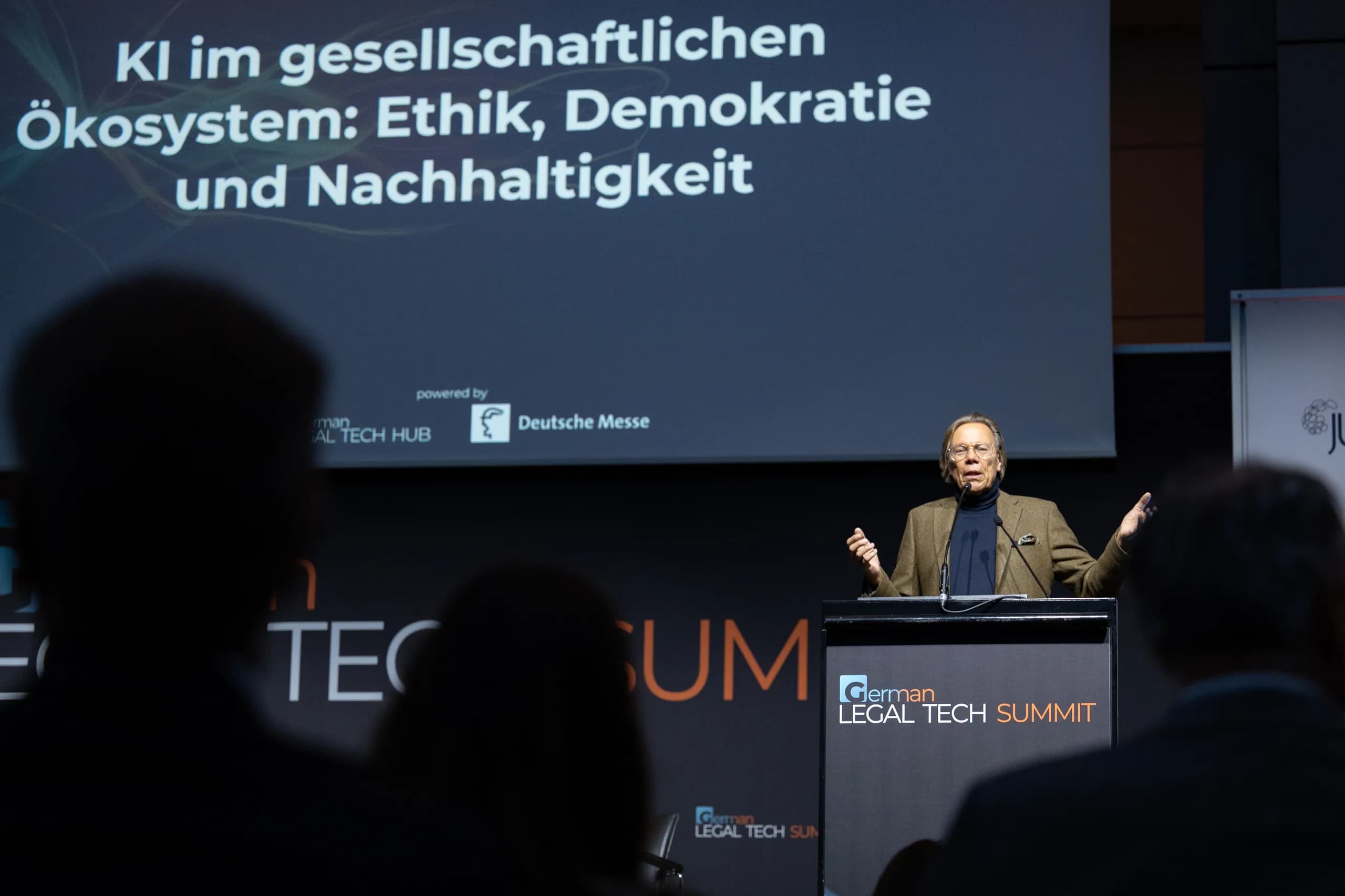
On 3 December, the German Legal Tech Summit comes to the HCC Hannover. Agentic Legal AI is the first of seven thematic clusters there, and Lower Saxony’s Minister-President Olaf Lies will speak on Digital Justice. According to the website, early-bird tickets are available until 18 October.
Numbers of the week
15.5 billion dollars – that is the valuation of the US company Harvey following its new funding round. On 9 September it raised 550 million dollars; in March it was 200 million at a valuation of 11 billion. Annual revenue stands at around 400 million dollars, and the valuation has more than tripled in just over a year. What is the money for? According to COO Katie Burke, mainly two things: staff and computing power, as Harvey expects a race for data centres next year. Whether this is a bubble is being openly debated in the industry. What is certain: whoever controls computing power also has a say in what legal work will cost in future.
79 per cent – that is how many executives at companies cannot reliably explain why their contracts contain the clauses they contain. This was the finding of a Censuswide survey commissioned by Luminance in the UK, the US, France and Germany. 98 per cent report financial or operational consequences when contract knowledge is lost. Only 26 per cent can search their entire contract portfolio quickly and reliably. This is exactly where Document Intelligence comes in. In fairness: the study comes from a provider that sells precisely this solution.
33 per cent – that is how many experienced legal professionals trust the results of their AI. At the same time, almost half of legal organisations have already firmly embedded AI into their workflows, reports Legal IT Insider. Every second one uses it, every third professional trusts it. This is not a technology problem. It is a trust problem, and trust is not created by a press release.
36 – that is how many senior partners the US law firm Vorys has now recreated as AI personas, together with a lab at Stanford Law School. Colleagues can have the digital partners review documents, suggest amendments and flag contractual risks. Next, personas of clients’ legal departments are to follow. The knowledge of the experienced is being preserved. What remains open is where the next generation of experienced professionals is supposed to come from.
Further reading
For those who want to dig deeper: Legal IT Insider has written up the unveiling of Astra for Law in detail, including the question of how much of a workflow AI handles before a human needs to step in. Artificial Lawyer explains in “Legal AI vs The Adversarial Incentive” why large law firms work hardly any differently despite AI. And LTO covers the entire debate about AI-generated legal briefs and the planned reform of procedural law, with voices from all the Bundestag parliamentary groups.
A few more developments from recent days in brief. Legora has launched “Skills”, a library of over 250 legal work instructions for AI agents, and, with “Intake”, an AI entry point for legal departments in Slack. Ironclad has unveiled its own contract agent that accesses the company’s contract knowledge. Ivo has released “Sage”, a freely available model for contract work that law firms can adapt themselves. And in China, Z.ai has launched its own language model solely for legal tasks.
References
Sources
- SourceLegal IT Insider: OpenAI unveils Astra for Law, 17.09.2026View ↗ (opens in a new window)
- SourceArtificial Lawyer: Harvey and LexisNexis, Cooley and Google, 09.10.2026View ↗ (opens in a new window)
- SourceArtificial Lawyer: AT&T and OpenAI develop AI workflows for LegalEdge, 08.10.2026View ↗ (opens in a new window)
- SourceLegal IT Insider: BMW Group rolls out Legora in its legal department, 08.10.2026View ↗ (opens in a new window)
- SourceArtificial Lawyer: Legal AI vs The Adversarial Incentive, 12.10.2026View ↗ (opens in a new window)
- SourceLaw.com: Legal Tech Integration Promises Meet Implementation Realities, 09.10.2026View ↗ (opens in a new window)
- SourceLawFuel: AT&T cuts list of external law firms, Ropes & Gray and AI training, 13.10.2026View ↗ (opens in a new window)
- SourceLTO: AI-generated legal briefs, quote from Stefanie Hubig and planned reform of procedural law, 25.09.2026View ↗ (opens in a new window)
- SourceBMJV, press release 44/2026: 210 million euros for the digitalisation of the judiciary, 11.06.2026View ↗ (opens in a new window)
- SourceLegal IT Insider: Harvey’s $15.5bn valuation – interview with Katie Burke, 17.09.2026View ↗ (opens in a new window)
- SourceLegal IT Insider: Legal tech news roundup (Luminance survey, Vorys, Legora Skills, Ivo Sage), 09.10.2026View ↗ (opens in a new window)
- SourceLegal IT Insider: Legal AI has a trust problem, 09.10.2026View ↗ (opens in a new window)