Legal tech trendsInterview
Hype or transformation? Where the legal market really stands on AI
In the interview, Dr. Benedikt Epe Quarch, Co-Director of the German Legal Tech Hub, assesses how far AI has already made inroads into law firms, legal departments, the judiciary and public administration – and explains why he expects it to significantly change everyday life in law firms within the next one to two years.

Some are already letting AI open client matters, while others are still wondering whether they're even allowed to upload client data. The German legal market is moving between the first automated processes and fundamental uncertainty, and is thus at the beginning of a genuine transformation. Julia Schmidt talks to Dr. Benedikt Epe Quarch, Co-Director of the German Legal Tech Hub, about how far law firms, legal departments, the judiciary and public administration have actually come, which new law firm models may emerge, and what is still holding back the broader use of AI.
AI has been at the centre of much discussion in the legal market for some time now. Has it already fundamentally changed it, or are we still at the beginning?
Epe Quarch: The fundamental change is already underway, but it has by no means arrived everywhere yet. Three levels need to be distinguished here. In terms of access to justice, citizens today can form an initial legal impression themselves much more easily. Particularly in straightforward cases, this is progress. At the same time, however, we also see the downside, for instance at social courts, which have to deal with a large number of AI-generated claims. Abroad, meanwhile, the first AI-based legal service offerings are emerging. One example is Garfield.Law in England and Wales, an AI-based law firm that helps companies enforce smaller claims.
In law firms and legal departments, the topic has by now reached almost everywhere. However, its use is still often selective: I enter something, get an answer, and then continue with my existing process. AI might replace a look into a commentary or a precedent book, but it doesn’t yet change the actual workflow itself. The real transformation only begins once AI is firmly integrated into the processes. Across the board, we are still at the beginning here.
The third level is the state, public administration and the judiciary. There, too, are the first projects. With SPARK, for example, it is being tested how AI can support public administration, including in drafting official notices. In the judiciary, initial solutions are being used in anonymisation, the preparation of statements of facts, and in mass proceedings. However, we are still far from widespread integration. So at all three levels, people have engaged with AI and gathered initial experience. Yet how far the transformation already reaches differs considerably.
Right now, however, is definitely the right time to continue pursuing the path of transformation and to embed AI firmly into processes – at all three levels.
The real transformation only begins once AI is firmly integrated into the processes.
You just mentioned an AI law firm in England. Can you imagine such a model existing in Germany in future as well?
Epe Quarch: I do believe so. In regulatory terms, though, Germany isn't as far along as England and Wales. There, the Solicitors Regulation Authority has, for the first time, authorised a purely AI-based law firm for regulated legal services with Garfield.Law. Garfield uses an AI-supported litigation assistant to help companies enforce outstanding claims through the small claims procedure. Authorised lawyers remain responsible for the work and its outcomes.
In Germany, we are initially seeing law firms that work with AI to a very large extent, where human lawyers review the results and take responsibility for them. We refer to these as “AI-first” or “AI-native” law firms. Early developments in this direction already exist. Even existing law firms could set up a second unit and bundle there the cases they want to handle using AI. Even if, to begin with, only 50 per cent of the work is done using AI, cases could still be handled far more efficiently and in greater numbers.
Whether legislation will at some point allow legal services in certain areas to be provided entirely by AI remains to be seen. In the US, developments are in some respects even further along: there is already a model in which professional indemnity insurance covers the AI output of a law firm. Whether such models will also come to Germany naturally depends on regulation and the insurance market. But ideas from abroad often become established here step by step. That’s why it’s worth looking beyond our own borders.
What distinguishes law firms that already use AI extensively from those that are still hesitant?
Epe Quarch: Those who test early find out more quickly which matters and work steps AI really helps with, and can then integrate it into their own processes in a targeted way. Realising that it doesn't bring much benefit in a particular area is also an important finding.
Which developments are currently overestimated, and which are perhaps underestimated?
Epe Quarch: In my view, what AI can already achieve in knowledge work today is often underestimated. I always say: we also need to give it hard problems. So really difficult tasks, large case files, or questions that involve several steps. Often, our first instinct is to think it won't manage that anyway. But only by trying can we really assess its potential.
AI is overestimated, on the other hand, when it is understood as an all-knowing machine that replaces us entirely. I also consider it exaggerated to think that at some point we will no longer need lawyers or courts. Law organises human coexistence. That is why people will always play a central role in it. Technology is not an end in itself. It is about improving our work and our lives.
Technology is not an end in itself. It is about improving our work and our lives.
The legal market is traditionally rather cautious. Why do we find innovation so difficult?
Epe Quarch: In my view, this starts back in legal education. We learn early on to prefer following the prevailing opinion and taking the well-trodden path. That's usually the safer route in an exam. This naturally doesn't foster a particularly innovation-friendly attitude.
On top of that, much in the legal market has proven itself over a long period of time, and regulation has grown accordingly. This often means there is no immediate incentive to change anything. But right now, those who try out new things have the chance to reposition themselves. That doesn’t mean suddenly having a completely different profession. You remain a lawyer, but you use technology differently, perhaps developing new offerings or new business models. We don’t need to throw all the guardrails overboard. But we should let go of the basic attitude of always preferring to take the familiar path.
Where are such new paths already emerging?
Epe Quarch: A good example is the role of Legal AI Engineer. Two years ago, hardly anyone had heard of it. Lawyers work together with AI providers or software companies here, contributing their professional expertise so that the tools are aligned as well as possible with legal working methods. This new professional profile is now gaining considerable significance.
Law firms and legal departments are also giving more thought to how young lawyers can learn to work with AI from the very start. This hasn't been perfectly solved everywhere yet, but the first steps are being taken. We see something similar at universities, where the first mandatory courses are emerging. It would be even better, in my view, if dealing with AI were eventually taken into account in the state examination as well. If we keep the existing examination system – which is itself a matter for good debate – this competence should also play a role within it.
Which changes will lawyers particularly feel over the next five years?
Epe Quarch: I see four changes. The first is greater technical independence. Over the past 20 or 30 years, lawyers have largely relied on IT companies for software matters. Today, with the help of AI, I can create my own solutions, at least for smaller everyday problems, for which I previously would have had to commission a company. This can make us more independent and open up new possibilities for legal work.
Second, the transformation will broaden. There will be fewer people hesitating and more actually using AI. Clients, too, will increasingly expect law firms to work with these tools, because they use them themselves. However, this can also mean that clients come to the firm with an AI-generated opinion that is not always professionally convincing. We need to prepare for that as well.
The third point is the connection of systems. Technologically, a great deal is already possible, but law firm software and case management systems are in some cases closed off. Over the next five years, I expect significantly more openness and interoperability – naturally while observing data protection and data security.
Fourth, the judiciary and the state will continue to adapt their processes. At the latest once courts, authorities and other law firms are working with such solutions, it will become almost impossible for a lawyer to avoid doing so without falling behind in terms of their own capabilities.
Change at the judiciary and the state will presumably take longer. But in day-to-day law firm life, we're talking more about one or two years than five, aren't we?
Epe Quarch: Definitely. At the latest once law firm software, Outlook, Word and AI solutions can be connected with each other comprehensively, easily, and in a way that complies with data protection and professional regulations, there will be no stopping it. Technologically, this is already possible today. It's primarily a question of the willingness of those involved.
Then agents with a high degree of autonomy will also be able to take over initial work processes, such as opening client matters or preparing an initial assessment for clients. This will also change law firm structures. After all, there are many other processes and parties involved around a given matter – from the secretariat through trainee lawyers and research assistants to enforcement. We therefore need to think about how a law firm will be organised in future. And that future is no longer particularly far away.
Which questions are you currently asked most often about the use of AI?
Epe Quarch: The most common question is how AI can be used in a legally sound way, used with client data, and connected to law firm software. Alongside that is the bigger question of where this development is heading. My view is positive: AI will make us better and create new professional fields, and it won't replace everyone.
Many law firms are unsure how to handle the use of AI towards their clients. Would you disclose which tools you use?
Epe Quarch: There is no general prohibition on using AI. If its use is properly set up, it can be designed in a way that complies with data protection and professional regulations. I also believe that many clients already expect lawyers to use AI as a tool in their processes, in finding solutions, and in handling matters. It's a different matter, of course, if a law firm works almost entirely with AI. In that case, it should say so clearly.
Generally, I would opt for transparency and also name the tools being used. This can be set out, for example, in the engagement agreement. In my view, explicit consent is not required in every case. Anyone who wants to be particularly safe can nevertheless provide for it.
Is there a question you are hardly ever asked, but would like to be asked more often?
Epe Quarch: Far too rarely are people asked how AI actually works technically. In my talks, I therefore often take time to explain, at least in broad terms, how the technology works with vector spaces and weightings. We don't need to go into mathematical detail. But anyone who wants to genuinely join the conversation about AI, rather than just having a vague negative feeling, should engage with how it works.
Reading a few good articles can already put you in a much better position. In my view, this also fits with the legal profession’s aspiration to understand and penetrate systems. Anyone who understands the fundamentals can assess the possibilities and limitations of AI more realistically.
So your appeal is to engage more intensively with AI. What role do formats such as the German Legal Tech Summit play in this?
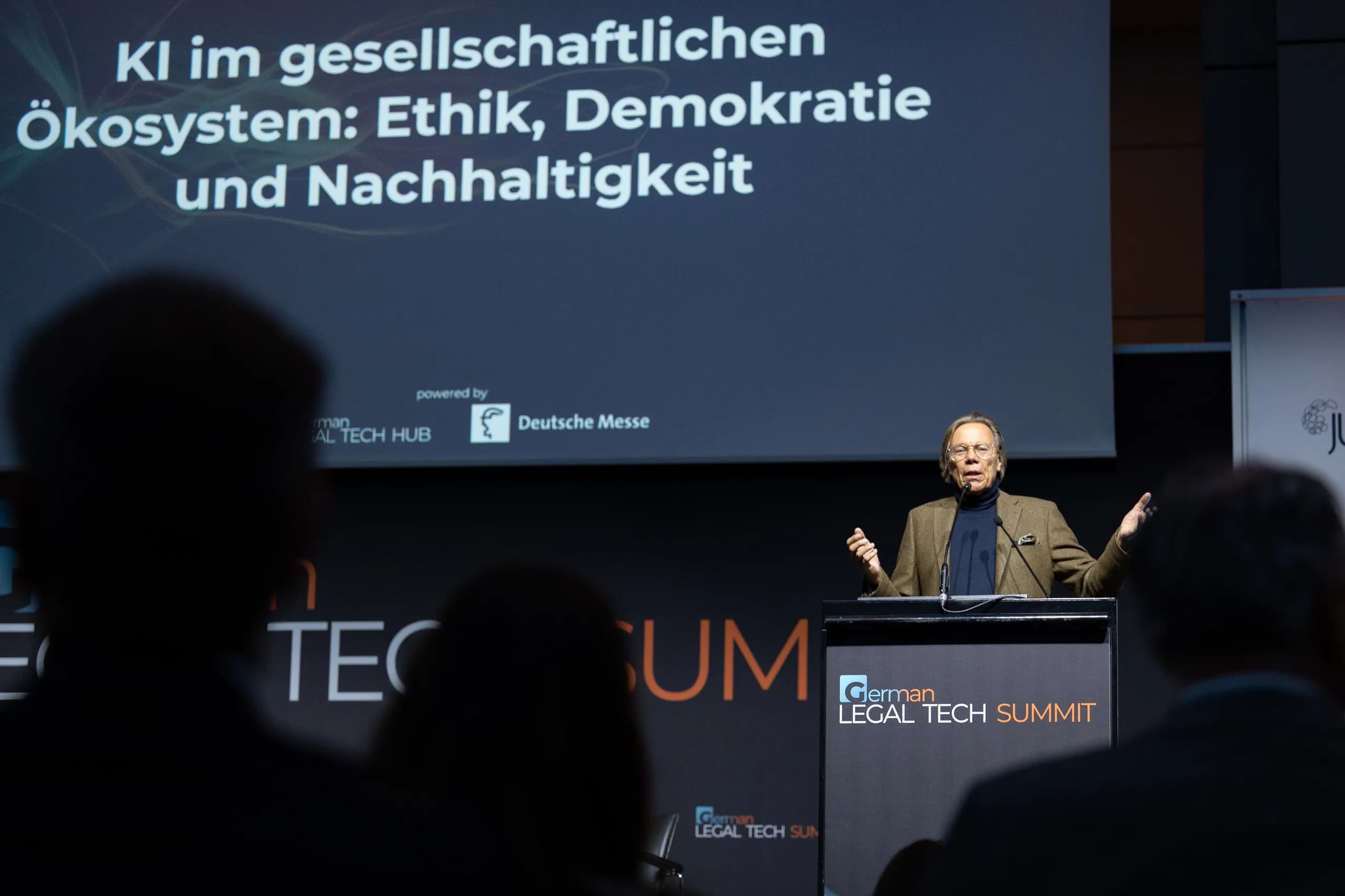
Epe Quarch: In-person events are highly valuable, especially in a heavily digitalised working world. There, people can exchange views on how others use AI, what experiences they're having, and how providers' solutions work.
Developing the legal market further requires direct exchange between legal practice, IT, AI development and businesses. This is precisely where the value of the German Legal Tech Summit lies.
If you had to commit to an answer at the end: are we still experiencing hype, or already a genuine transformation?
Epe Quarch: For me, it's clearly the transformation. Of course, there's still an element of hype, for instance when you look at some stock market valuations. But when I look at what the technology can already do today and what some in our market are already doing and achieving with it, I'm clearly on the side of transformation. Across the board, however, we're still at the beginning.
How would you recognise that the German legal market has changed sustainably?
Epe Quarch: For me, that's achieved once AI is no longer used only selectively but is firmly integrated into the daily processes of law firms, legal departments and the state, with the systems connected to one another. If work steps that people carry out today are, in future, taken over or prepared by AI, it's not just a single work output that changes, but our way of working.
A further step would be law firms openly stating that they handle a very large share of their work with AI and can therefore perhaps offer cheaper services or different pricing models. What's crucial for now, however, is that AI becomes widely established in processes.
Thank you very much for the conversation, Dr. Benedikt Epe Quarch.
Secure your ticket for the Summit

Media partner of the German Legal Tech Summit 2026
Deutscher Anwaltverlag & Institut der Anwaltschaft publishes the Anwaltspraxis Magazin, in which this interview first appeared, and is accompanying the Summit as a media partner. More about the media partner
This interview first appeared in Anwaltspraxis Magazin published by Deutscher AnwaltVerlag (22.10.2026). The interview was conducted by Julia Schmidt. Reproduced with kind permission.
References
Sources
- SourceFirst published: Anwaltspraxis Magazin (Deutscher AnwaltVerlag), 22.10.2026